
Begin a Zanesville Residents Directory Search
Start with the information already tied to the question. The Muskingum County Auditor accepts a parcel, owner, or address, so it is the practical first stop for a documented property. The Recorder then connects a named party to a recorded land instrument. For an individual civic check, Ohio My Voter Information requires first name, last name, and county. It can confirm an individual registration path, precinct, and polling location, but it is not a public list of everyone on a block. A court name search can add a case lead, while Probate and the library are often stronger for historical work.
These records are clues with boundaries. An owner is not necessarily an occupant. A deed traces title rather than every household member. A court address can be old. Keep the source, its date, and a parcel or case number with each result. That makes it less likely a same-name match becomes a mistaken identification.
- Search the Muskingum County Auditor by address, owner, or parcel and confirm the property.
- Use the parcel or owner lead in the Muskingum County Recorder index.
- For an individual registration question, use Ohio My Voter Information with first name, last name, and Muskingum County.
- Compare a historical name or address against a dated directory, newspaper notice, cemetery lead, or Probate record.
- When an index stops, ask the relevant custodian for inspection, a copy, or its request procedure.
Zanesville Residents Directory Custodians
Zanesville is the Muskingum County seat, which puts important but separate record systems near the county courthouse. The Auditor is the county-facing property entry point. The Recorder holds title instruments, plats, liens, and other recorded documents. The Clerk of Courts manages the Common Pleas docket. Probate keeps its own estate, marriage, early vital, and naturalization material. City offices serve another role: Building and Code Enforcement has address-centered project and enforcement files, while Engineering and GIS routes map, ward, and service questions.
The non-web channels are part of the search. The Recorder takes certified-copy requests at the counter, by mail, or by phone with advance payment. Probate will consider a genealogy request by email or mail when an exact name and approximate date are supplied. The Clerk provides full or certified court copies at the office or through mail rather than fax or email. Use those routes when a public index shows only a lead.
Note: Office hours and online interfaces can change, so confirm the custodian’s current instructions before a visit or paid copy request.
Zanesville Property Records Start Here
The Auditor’s property landing screen uses one combined field labeled “parcel, owner, or address.” It offers three supported ways to reach a property lead. An address search should be checked against the parcel’s physical location and legal description. An owner-name result is only a starting point, especially where names repeat. If the live card displays a mailing address, it is correspondence information and not proof that the owner currently lives at the property.
County GIS metadata helps connect a map polygon to property sources. Its parcel service identifies such geographic fields as parcel number, legal description, location address, deed volume or page, conveyance date, and links to Auditor, Treasurer, and Recorder information. Geographic data is useful for a property trail, but it is not a household list. The Zanesville streets reference handles the deeper address and map workflow.
| Auditor field | Type | Required | Verified use |
|---|---|---|---|
| parcel, owner, or address | Combined text search | No visible marker | Enter a parcel identifier, owner name, or street address |
| Advanced controls | Not captured | Not captured | Do not assume additional filters without inspecting the live service |
Open the Auditor property search before using the screenshot below. It shows the county entry point for a Zanesville residents directory property lead.
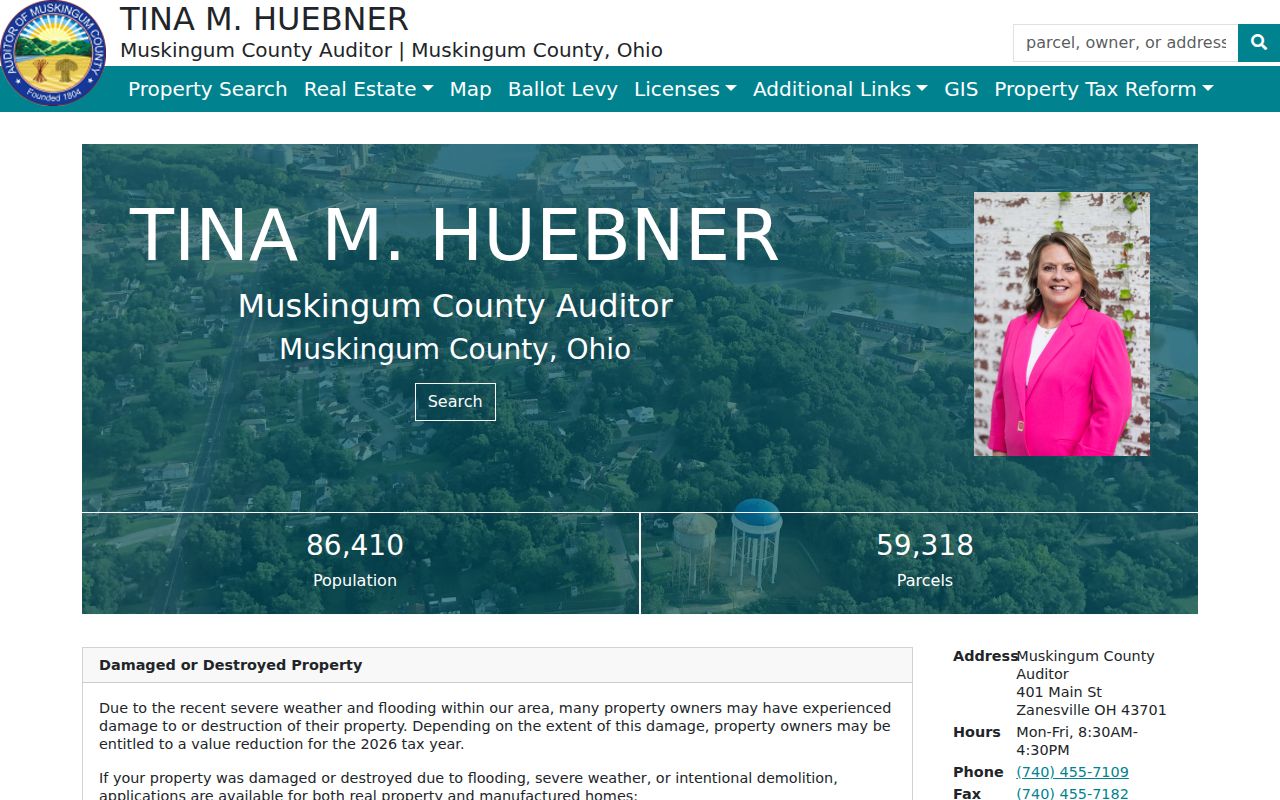
A parcel result still needs corroboration from a deed record and, for past households, dated historical material.
Zanesville Recorder Index Dates Matter
The Recorder holds documents dating to 1803, but its electronic index does not begin on one universal year. The office states electronic starts of 1977 for deeds, 1976 for mortgages, 1975 for liens and miscellaneous records, 1981 for leases, 1965 for military discharges, 1800 for plats, and 1993 for UCCs. A result that stops before 1977 does not mean old records disappeared. The Recorder directs earlier research to its Historical Indexes tab.
For a house or family history, carry the legal description from the Auditor to the Recorder. Find the current recorded owner’s acquisition as grantee, identify the seller, and work backward using the seller’s earlier acquisition. That traces title. It does not establish that every owner or grantor lived at the address. Plats, annexations, alley vacations, street-name changes, and centerline surveys help when an old address no longer fits the current map.
The Recorder records page supplies these index paths and its copy route.
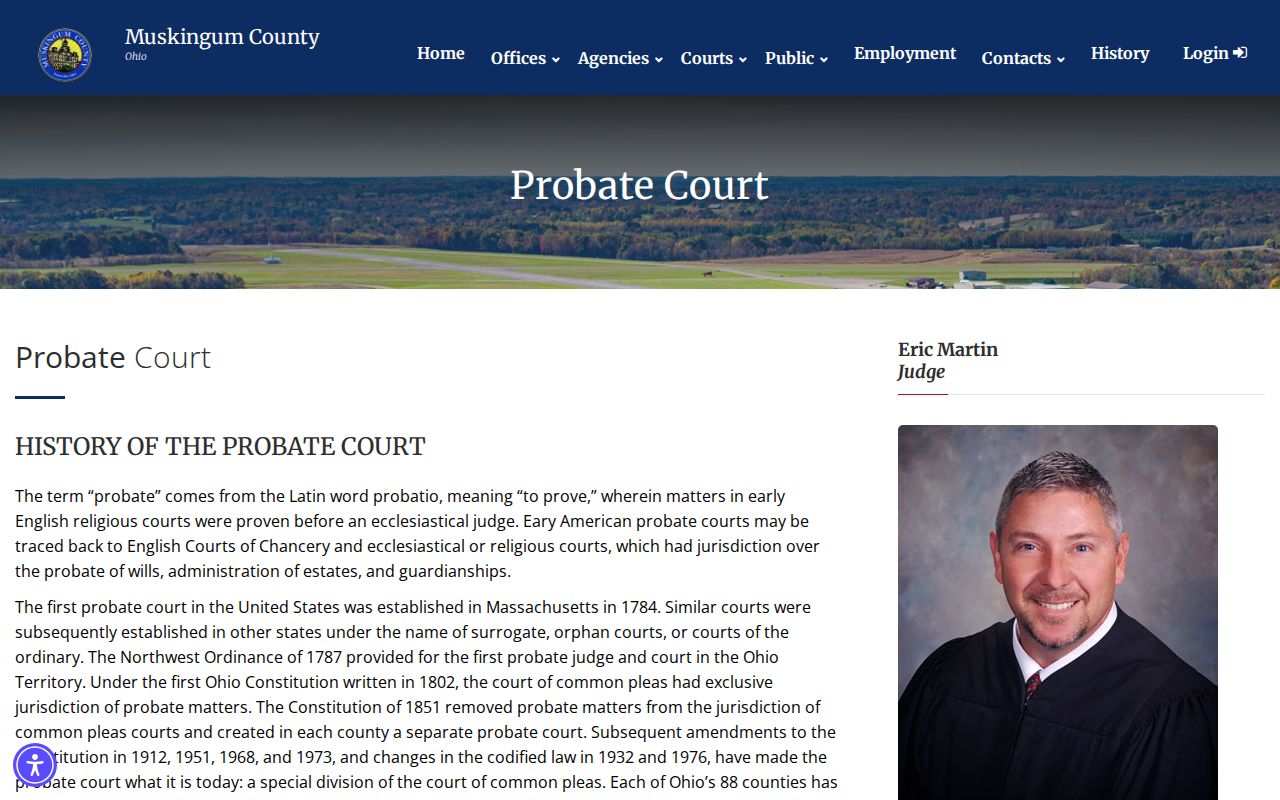
A deed index, Probate request, and library directory may each answer a different part of one local timeline.
Why Zanesville’s County Seat Matters
The county seat concentrates record systems without making them interchangeable. Common Pleas civil, felony criminal, domestic-relations, and Fifth District appellate dockets run through the Clerk’s online gateway from October 17, 1994. The service is a docket summary, not a complete-file archive. A reader who needs a full or certified document can ask the Clerk. Its cited copy charge is $0.20 per page, with $5 per certified document, and a total changes with the request.
Probate is separate. It holds marriages and wills or estates from 1804 to the present, births and deaths from 1867 through 1908, and early naturalizations. Probate has no general internet record index according to the Clerk’s FAQ. A request needs an exact name and approximate date. After-1908 birth and death events are routed to the Muskingum County Health Department, with an Ohio Department of Health channel for current certified copies.
See the Common Pleas electronic-search gateway before using the screenshot.
A docket match needs a case number, court division, party, and filing-date check before it is tied to a particular person.
Zanesville Voter Lookup Limits
Ohio My Voter Information is a narrow individual lookup. It requires first name, last name, and county, followed by a possible street-name refinement. Its stated purpose is registration, precinct, and polling-place information. The official tips allow for a former surname, nickname, or prior Ohio county when those facts are relevant. A non-match does not establish that someone is absent from Zanesville or unregistered elsewhere.
Ohio election records have public and confidential parts. Safe at Home participant information is excluded from the public voter function, and citizenship proof, sensitive identifiers, ballot choices, and protected address data do not belong in a resident search. Muskingum County Board of Elections is the right human channel for a defined request, correction, or precinct question. Ohio Revised Code § 149.43 supports access to public records while preserving necessary exemptions and redactions.
Note: An individual registration result is not permission to assemble or publish a street-wide list of neighbors.
Zanesville Court Records Need Context
Common Pleas has two documented online modes: party name and case number. Its summary docket can list parties, attorneys, a brief description of filed items, a docket or event timeline, and case-level summary information. It does not display complete filings. A case match is a lead that needs identity checks, not proof of someone’s current address or personal history.
Zanesville Municipal Court has a distinct local role. Its Case Lookup supports Party or Company Name, Case Number, Hearing Date, File Date, Violation Date, case-type options, and matches-per-page settings after the disclaimer. The court warns that online posting is delayed at least 24 hours. Probate and Juvenile do not use the Common Pleas internet service, so counter, phone, mail, and dated-request channels remain essential.
Use the Zanesville Municipal Court for its official records route before relying on a third-party summary.
Current Zanesville Resident Directories
There is no official roll of every Zanesville household. The current sources are limited by their purpose. The Auditor and Treasurer are property and tax tools. The Recorder indexes named parties to recorded documents. The voter system addresses an individual registration question. City staff listings identify public employees and departments, not private residents. Use each source only for the record relationship it documents and compare another time-appropriate source when identity matters.
| Source | What it identifies | Keeper | Access boundary |
|---|---|---|---|
| Property search | Parcel, owner, or address lead | County Auditor | Public property tool, not an occupant roster |
| Recorded-document index | Parties to deeds, plats, liens, and related filings | County Recorder | Free index after disclaimer; certified copies use office route |
| Voter information | Individual registration, precinct, and polling-place path | Ohio Secretary of State | First name, last name, county; protected data excluded |
| Court docket | Named case connection | Clerk or Municipal Court | Summary or court-specific record, subject to redaction |
| City staff directory | Department staff and public contacts | City of Zanesville | Public-service directory, not a residents directory |
A commercial people-finder category can be stale, merge same-name records, and omit protected information. Official custodians permit a reader to check the actual record and ask for a correction where appropriate.
Zanesville Vital and Probate Trails
Probate’s local dates create a family-history timeline. It holds births and deaths from 1867 to 1908, marriages from 1804 to the present, and estate and will material from 1804 to the present. County civil birth and death records do not exist before 1867 according to Probate. After-1908 events use the County Health Department or Ohio Department of Health Vital Statistics route.
Ohio Revised Code § 3705.23 requires a signed application and fee for a certified vital copy, subject to its exceptions. It does not set a simple statewide closure period. The medical and health-use part of a birth record stays restricted, and a decedent’s Social Security number is omitted during the first five years except for eligible authenticated requesters. A marriage or estate event can document a historical transition but does not establish a current household.
- Parcel
- A defined piece of real property that connects an address with land and tax records.
- Index
- A finding tool that points to a record and may not include its full image or a certified copy.
- Criss-cross directory
- An address-organized historical directory, if a particular local edition exists.
- Certified copy
- A copy issued by the custodian with requested certification.
Zanesville Library History Resources
John McIntire Library is the main local shelf for directories, dated newspapers, and history material absent from a current county index. Its Family History Center is on the second level, and published visitor information identifies past local newspapers on microfilm as well as Zanesville and Muskingum history collections. Its research databases include Ancestry Library Edition, FamilySearch access with some image limits, HeritageQuest, Fold3, NewspaperARCHIVE, Sanborn maps, and the Norris Schneider WWII Muskingum County Veterans Archive.
The library reopened on May 1, 2026 following work that expanded its family-history setting. Confirm genealogy-room hours and the exact volume, microfilm run, or database access before traveling. Some FamilySearch images are accessible only at an affiliate or library computer, which makes an in-person visit a meaningful access channel.
Open the Muskingum County Library System research databases before arranging a directory or newspaper search. Library evidence must stay tied to its edition, collection, and date.
Zanesville State Record Boundaries
Some official state tools answer a narrow question rather than locating a resident. The Ohio Department of Rehabilitation and Correction Offender Search is a state-custody locator. It is distinct from local booking information, a Common Pleas docket, or a general directory. It cannot identify every local arrest, county detainee, released person, or federal inmate. Use the official tool only for its stated public purpose and follow its notices.
The screenshot shows the state search entry used for this specific type of record. A result-free search does not prove that a person has no local court or custody record.
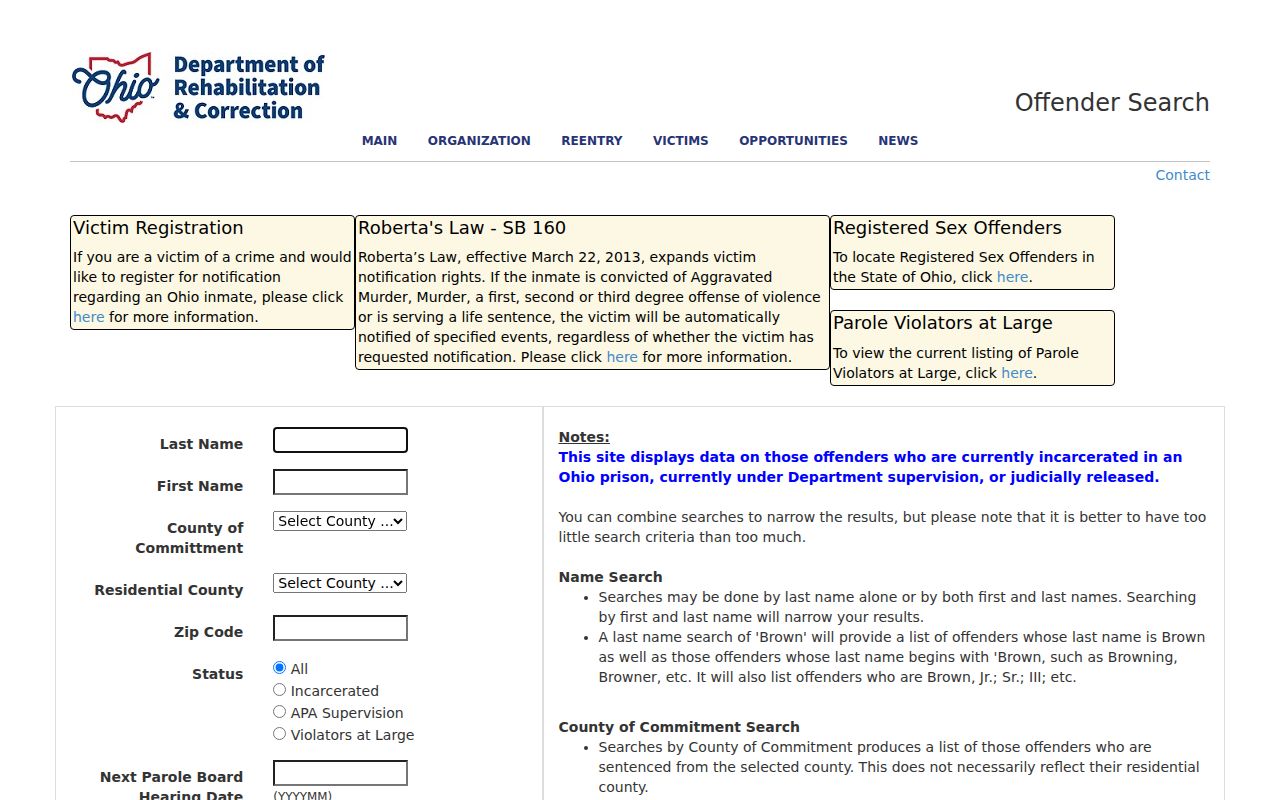
For a defined city court or incident question, use the appropriate Zanesville court or police records channel instead.
Zanesville Privacy Lines in Records
Ohio public-record access is broad, not unlimited. R.C. 149.43 allows any person to inspect public records and generally makes inspection free, while an office may need time for a defined request, redaction, or legal review. A precise request names the record category, relevant dates, a parcel or case number when known, and a preferred inspection or copy method. The office can identify the legal basis for a withheld or redacted part.
Safe at Home protects eligible participant identity and address information. Court files can exclude personal identifiers, and juvenile, sealed, expunged, adoption, victim, medical, and protected voter information follow separate limits. Ohio also has an R.C. 149.45 request path for covered personal information in internet-posted records. Corrections belong with the actual custodian, such as the Auditor for property mailing data or the Board of Elections for voter information.
View the Ohio Public Records Act before making a request.
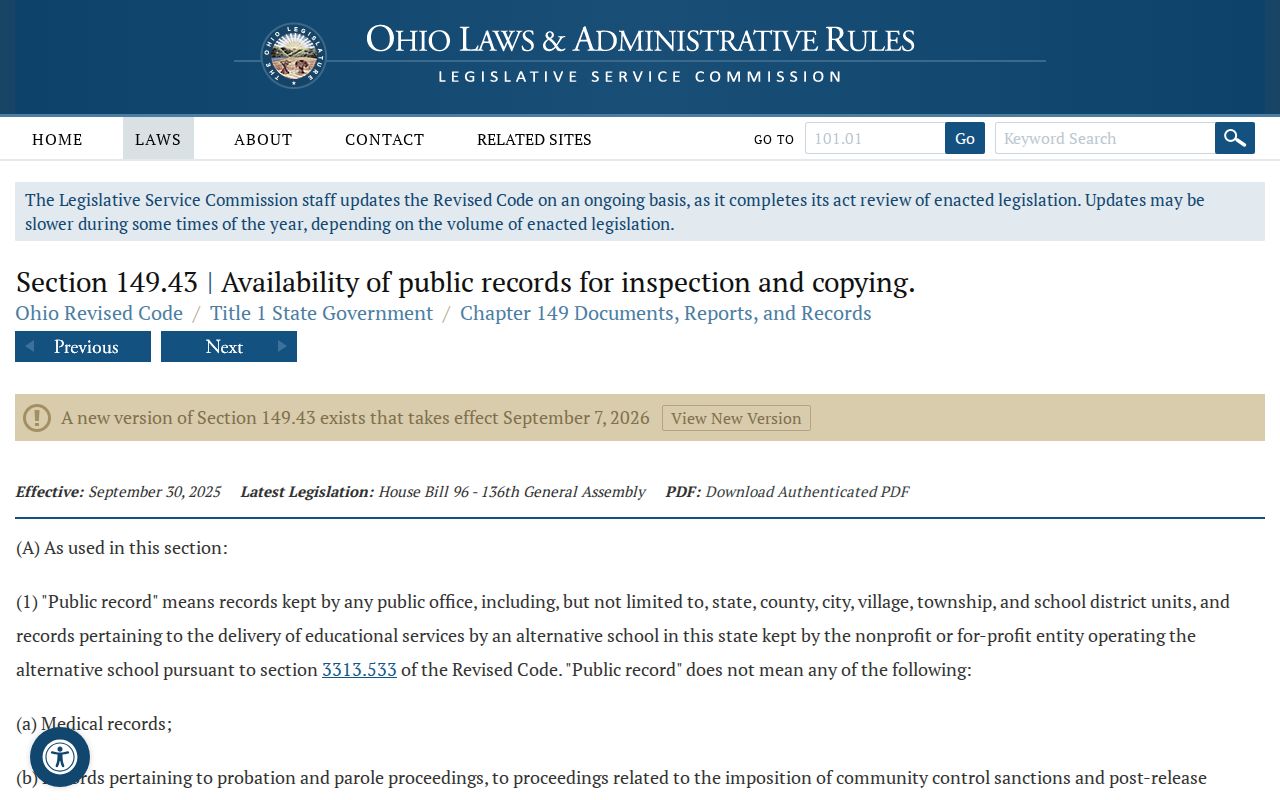
The statute establishes access rules, but every custodian controls its own records and confidential material.
Historic Zanesville Residents Directories
Ohio Genealogical Society holdings provide a real, uneven local timeline: 1851; 1890–91; 1916; selected years from 1926 through 2004; and important gaps. The documented 1890–91 Burch & Co. directory has more than 11,100 mostly head-of-household names, addresses, and occupations. A missing year should lead to a nearby edition, newspaper microfilm, tax or deed record, or Probate event, not an assumption that a volume exists for every year.
City directories are historical snapshots. Transcribe the printed name, address, occupation, edition, and page, then compare adjacent years before inferring a move or family connection. The fuller Zanesville city directory collection treatment follows the shelf years, library channels, and reading method without turning an old entry into a current-contact claim.
Note: Historic listings document a printed date and address association, not current residence or every household member.